AI automation is revolutionizing the way businesses operate, offering a myriad of benefits from increased productivity to cost savings. In this informative post, we will investigate into the world of AI automation and explore how implementing this cutting-edge technology can maximize efficiency in your business operations. By leveraging AI-powered tools, you can streamline tasks, improve accuracy, and free up valuable time for your team to focus on strategic initiatives. Let’s unlock the potential of AI automation and propel your business towards success.
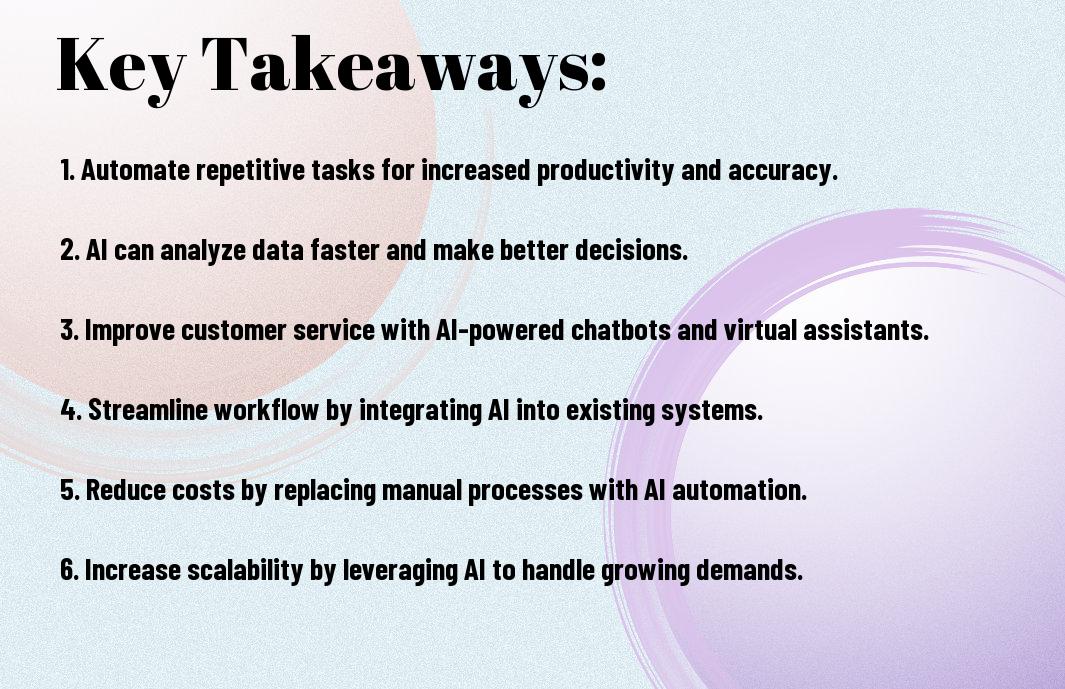
Key Takeaways:
- Automate Routine Tasks: AI automation can streamline your business by taking over repetitive and time-consuming tasks, allowing your employees to focus on more strategic and creative work.
- Enhance Decision-Making: By analyzing large datasets quickly and accurately, AI can help businesses make data-driven decisions faster and more efficiently, leading to better outcomes.
- Improve Customer Experience: AI automation can personalize customer interactions, provide timely responses, and offer tailored recommendations, enhancing the overall customer experience and satisfaction.
- Increase Operational Efficiency: By optimizing processes and workflows, AI automation can reduce errors, minimize delays, and ultimately increase the efficiency of your business operations.
- Stay Competitive: Embracing AI automation can help your business stay ahead of the competition, adapt to market changes faster, and unlock new opportunities for growth and innovation.
The Current State of Business Operations
The 10 Ways AI Can Streamline Your Business Operations are constantly evolving in response to technological advancements. Businesses today operate in a fast-paced environment where efficiency and effectiveness are crucial for success. Traditional processes can often be cumbersome and time-consuming, leading to inefficiencies that hinder productivity.
Inefficiencies in Traditional Processes
For many businesses, traditional processes involve manual data entry, paper-based documentation, and repetitive tasks that are prone to errors and delays. These inefficiencies not only slow down operations but also increase the likelihood of mistakes that can have serious consequences. By leveraging AI automation technologies, businesses can streamline their processes, eliminate errors, and improve overall efficiency.
The Cost of Human Error
State-of-the-art AI automation systems can significantly reduce the cost of human error in business operations. Human error can result in financial losses, damaged reputation, and decreased customer satisfaction. With AI automation, tasks that were previously error-prone can be performed accurately and efficiently, saving time and resources. By investing in AI technologies, businesses can minimize the risks associated with human error and achieve higher levels of operational excellence.
The Rise of AI Automation
Some believe we are on the cusp of a new era in business operations – one where AI automation plays a central role in streamlining processes and maximizing efficiency. This technology has the potential to revolutionize how businesses operate, offering solutions to complex problems through the power of artificial intelligence.
Defining AI Automation and Its Capabilities
For businesses looking to enhance productivity and reduce manual errors, AI automation holds immense promise. This technology involves the use of algorithms and machine learning to perform tasks that traditionally required human intervention. From data analysis to customer service, AI automation can handle a wide range of functions with speed and accuracy.
Early Adopters and Success Stories
Stories abound of companies that have embraced AI automation and reaped the rewards. Early adopters in industries such as finance, healthcare, and manufacturing have reported significant improvements in efficiency, cost savings, and customer satisfaction. By integrating AI automation into their operations, these businesses have gained a competitive edge and positioned themselves for future success.
Automation has enabled these companies to streamline processes, identify patterns in data, and make informed decisions in real-time. The success stories of these early adopters serve as compelling evidence of the transformative power of AI automation in the business world.
Streamlining Business Functions
Despite the numerous benefits that AI automation can bring to your business, the key lies in utilizing it effectively across various functions. By streamlining business processes with AI automation, you can optimize efficiency, minimize errors, and free up time for your employees to focus on more strategic tasks.
Automating Repetitive Tasks
On the surface, automating repetitive tasks may seem like a small change, but the impact can be substantial. AI can handle mundane and time-consuming tasks such as data entry, scheduling, and basic customer inquiries. By entrusting these tasks to AI, your employees can dedicate their time and energy to more complex and high-value activities, leading to increased productivity and job satisfaction.
Enhancing Customer Service
For businesses looking to elevate their customer service, AI automation offers a wealth of possibilities. Chatbots can provide instantaneous support to customers, offering quick resolutions to common queries and issues. Additionally, AI can analyze customer data to personalize interactions, anticipate needs, and provide proactive support. By implementing AI in customer service, businesses can improve satisfaction levels, increase loyalty, and drive repeat business.
This level of personalized customer experience can set your business apart from competitors and build long-lasting relationships with your customers. It also allows you to gather valuable insights from customer interactions, helping you refine your products or services to better meet their needs.
Improving Data Analysis and Decision-Making
Businesses today are inundated with vast amounts of data, making it challenging to extract valuable insights and make informed decisions. AI automation can streamline data analysis processes by rapidly sorting, analyzing, and interpreting data to identify trends, patterns, and opportunities. By leveraging AI for data analysis, businesses can make smarter decisions faster, optimize operations, and stay ahead of the competition.
Customer preferences, market trends, and operational performance metrics are just a few examples of the data that AI can analyze to provide actionable insights. With AI automation, businesses can transform raw data into strategic intelligence, enabling them to make data-driven decisions that drive growth and success.

Implementing AI Automation
Not every business is at the same stage when it comes to implementing AI automation.
Assessing Business Needs and Identifying Areas for Automation
is crucial before submerging into the world of AI. Areas that are repetitive, time-consuming, or prone to human error are excellent candidates for automation. By pinpointing these areas, businesses can prioritize their automation efforts and maximize the benefits of AI technology.
In the context of
Choosing the Right AI Automation Tools and Partners
, businesses must consider their specific needs, budget, and long-term goals. Businesses should conduct thorough research, solicit recommendations, and explore different options to find the Business that best suits their requirements. It’s crucial to select tools and partners that align with the company’s values, have a proven track record, and offer excellent support and training resources.
Assessing the capabilities and compatibility of AI automation tools with existing systems is crucial to ensure a smooth integration process. Businesses should also consider the scalability and flexibility of the tools to meet future requirements as the business grows. Seeking out partnerships with experienced AI automation providers can provide valuable insights and expertise to navigate the complexities of implementing automation effectively.
Training and Onboarding Staff
is an crucial step in the successful implementation of AI automation. Any new technology introduces change, and it’s vital to prepare employees for this shift. Training programs should be comprehensive, engaging, and tailored to the different roles within the organization. Employees need to understand the benefits of AI automation, feel confident in using the new tools, and see how it can enhance their work processes.
With proper training and onboarding, employees are more likely to embrace AI automation, leading to increased efficiency, productivity, and job satisfaction. It’s crucial for businesses to foster a culture of continuous learning and adaptability to leverage the full potential of AI technology.
Overcoming Common Challenges
Addressing Job Displacement Concerns
After implementing AI automation in a business, one common concern that arises is job displacement. Employees fear that the automation of tasks previously done by humans will lead to job cuts and redundancies. However, it’s crucial to emphasize that AI automation is not about replacing jobs, but about augmenting them. By automating repetitive and mundane tasks, employees can focus on more strategic and creative aspects of their roles.
Ensuring Data Security and Compliance
One crucial aspect that businesses must prioritize when integrating AI automation is data security and compliance. One of the biggest challenges in adopting AI technology is the potential risk of data breaches and non-compliance with regulations such as GDPR. Implementing robust security measures and ensuring compliance with data protection laws are crucial to build trust with customers and protect sensitive information.
This is especially important in industries like healthcare and finance, where data privacy concerns are paramount. Businesses must invest in secure AI systems and regularly audit their processes to mitigate the risks associated with data security breaches.
Managing Change and Cultural Shifts
Compliance with data security regulations is not the only challenge when implementing AI automation. Managing change and cultural shifts within an organization is also crucial. Employees may resist adopting new technologies due to fear of the unknown or lack of understanding. Plus, there may be a need for upskilling or reskilling to ensure employees are equipped to work alongside AI systems.
This requires strong leadership, effective communication, and a supportive organizational culture that encourages innovation and embraces change. By involving employees in the transition process, addressing their concerns, and providing training and support, businesses can ensure a smoother integration of AI automation into their operations.
Measuring Success and ROI
Once again, it’s crucial to measure the success and return on investment (ROI) of implementing AI automation in your business. This step is vital to understand the impact of automation on your processes and bottom line. By tracking specific metrics and analyzing data, you can assess the effectiveness of AI automation and make informed decisions to maximize efficiency.
Key Performance Indicators (KPIs) for AI Automation
Performance tracking is key to evaluating the success of AI automation. Some vital KPIs to consider include operational costs savings, processing time reduction, error rate minimization, and overall productivity improvements. By monitoring these metrics, you can identify areas where automation is making a positive impact and areas that may require further optimization.
Calculating Cost Savings and Productivity Gains
Gains in cost savings and productivity are tangible results of AI automation implementation. Calculating the exact savings and gains can be done by comparing the cost of manual labor and the resources required for automation. Additionally, measuring the increase in output and efficiency post-automation provides insights into the overall impact on productivity.
Savings can be substantial when considering the reduction in human errors, decreased processing time, and optimized resource utilization. Productivity gains can be seen through the ability to handle larger volumes of tasks efficiently and reallocating human resources to more strategic initiatives.
Continuous Monitoring and Improvement
Improvement is an ongoing process when it comes to AI automation. Continuous monitoring of KPIs allows you to track progress, identify bottlenecks, and make necessary adjustments for further optimization. By regularly reviewing performance metrics and obtaining feedback from users, you can ensure that automation is delivering the expected results and driving efficiency across your business processes.
Measuring
Measuring success and ROI through KPIs, cost savings, productivity gains, and continuous monitoring is crucial for the long-term success of AI automation in your business. By prioritizing data-driven decision-making and actively seeking opportunities for improvement, you can maximize the benefits of automation and stay ahead of the competition.
Final Words
Drawing together the various points discussed in this article, it is evident that AI automation has the potential to revolutionize the way businesses operate. By integrating AI technology into their processes, companies can streamline operations, boost productivity, and ultimately increase their bottom line. It is crucial for businesses to embrace this technological shift and explore the various ways in which AI automation can be implemented to enhance efficiency and drive growth.
As we look towards the future, it is clear that AI automation will continue to play a pivotal role in shaping the business landscape. By staying informed about the latest advancements in AI technology and being proactive in adopting these innovations, businesses can position themselves for success in an increasingly competitive marketplace. The key lies in embracing change, adapting to new technologies, and leveraging the power of AI to drive efficiency and streamline operations.
FAQ
Q: What is the importance of maximizing efficiency in a business?
A: Maximizing efficiency in a business is crucial as it helps in reducing costs, saving time, and improving overall productivity.
Q: How can AI automation help streamline business processes?
A: AI automation can streamline business processes by automating repetitive tasks, improving decision-making processes, and enhancing overall workflow efficiency.
Q: What are some key benefits of implementing AI automation in a business?
A: Some key benefits of implementing AI automation in a business include increased productivity, reduced errors, improved customer service, and cost savings.
Q: How can businesses effectively integrate AI automation into their existing processes?
A: Businesses can effectively integrate AI automation into their existing processes by conducting a thorough assessment of their workflow, choosing the right AI tools, providing proper training to employees, and continuously monitoring and optimizing the automated processes.
Q: Can AI automation replace human workers in a business?
A: While AI automation can handle repetitive and mundane tasks, it cannot completely replace human workers. Instead, it can free up employees to focus on more strategic and creative tasks, ultimately enhancing overall business performance.